Stop Struggling with Word Lists: How Contextual Learning Makes Vocabulary Stick
Posted on 12/2/2025
5 minute read
Still memorizing word lists?
Last week, I learned and remembered 40 words. This week, I'd forget 38 of them. I'm making barely any progress! Does this sound familiar to you?
This is not a mere coincidence, and it's not because you or I have a poor memory. Retaining new information without context, imagery, or familiarity is tough. Multiple empirical studies confirm that vocabulary learned in isolation, without review, decays rapidly.
You're probably reading this because you relate to this. You might already realize that there are methods that can engage your brain more, but perhaps you don't know where to start. Here's how you could.
Disclaimer: People learn differently; memorizing word lists may be exactly what you need. The purpose of this article is not to tell you to forego word lists, but to help educate people on contextual learning.
Learners collect words but don't connect them
How often do we check a word list or a deck of flashcards, remember each word, tick it off our checklist, and move on to the next word?
Spaced repetition helps combat this. If you are not familiar, it works by revisiting the words you've learned at gradually increasing intervals, so each time you recall a word, you strengthen your memory of it over a longer period.
Anki is well-known for widely adopting this technique, and it's what makes it such a powerful tool for recall.
But when it comes to moments where we have to actively use the language, our brains do more than recall. They need to remember grammar patterns, the correct words to use, and the main point you're trying to make. Connecting words together is something our brains are doing constantly, and this is where we need to train to improve.
So the first thing is to shift your perspective. Don't see learning new words as your groceries list. There's more to it than that. Also, don't be disheartened if you forget them once in a while. This always happens, even in our native languages!

Too many new words, not enough connections
How do we train our brains to connect words together?
Frequently combining reading and listening is key. All material in Linguapon is accompanied by audio. Hearing the word instead of simply seeing it helps build imagery in your mind.
Learning sentences specifically helps build associations between words and teaches you contextual nuances.
Contextual nuances are something word lists alone cannot teach. Learning the Spanish word llevar on a list doesn't tell you it can mean take, carry, or wear. We need to see this word in action.
This is something we can meaningfully learn with translations on Linguapon. In the Explore section of the website, we can quickly find examples of all three meanings.
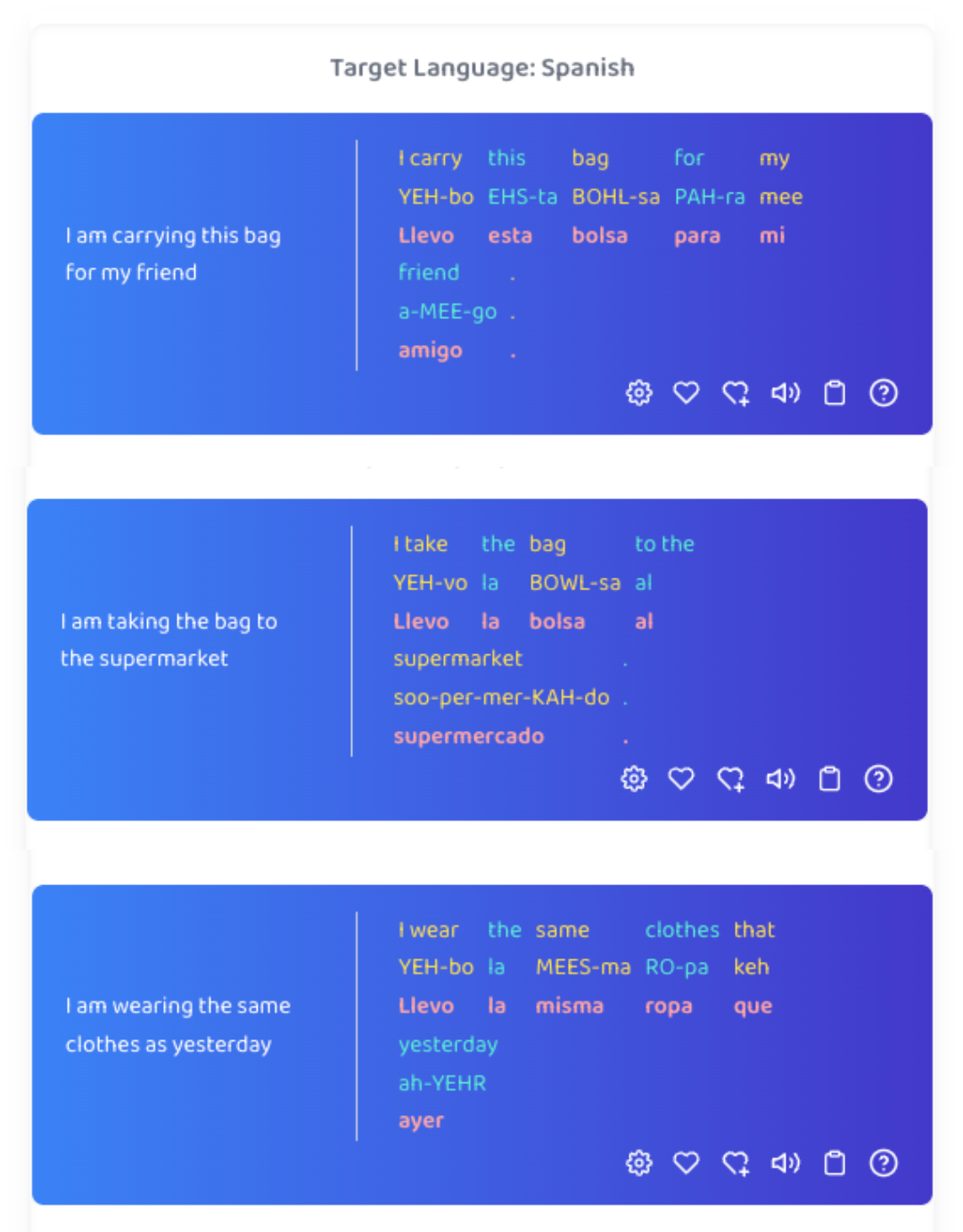
I tend to do this with words or expressions I'm curious about. When I see other words that come together to form these sentences, if I already knew them, it validates my knowledge. Otherwise, I'm forming new associations or learning new words for the first time.
Look deeper after saving a word
Seeing the meaning of a word while reading is helpful, but it's only the first layer of understanding.
Many words look simple on the surface but behave very differently once you try to use them yourself. For example, you might see llevar translated as "to take", but that doesn't tell you when Spanish uses llevar instead of tomar, or why llevar also appears in the sense of "to wear" or "to carry". You know what it means, but you don't yet know how it works.
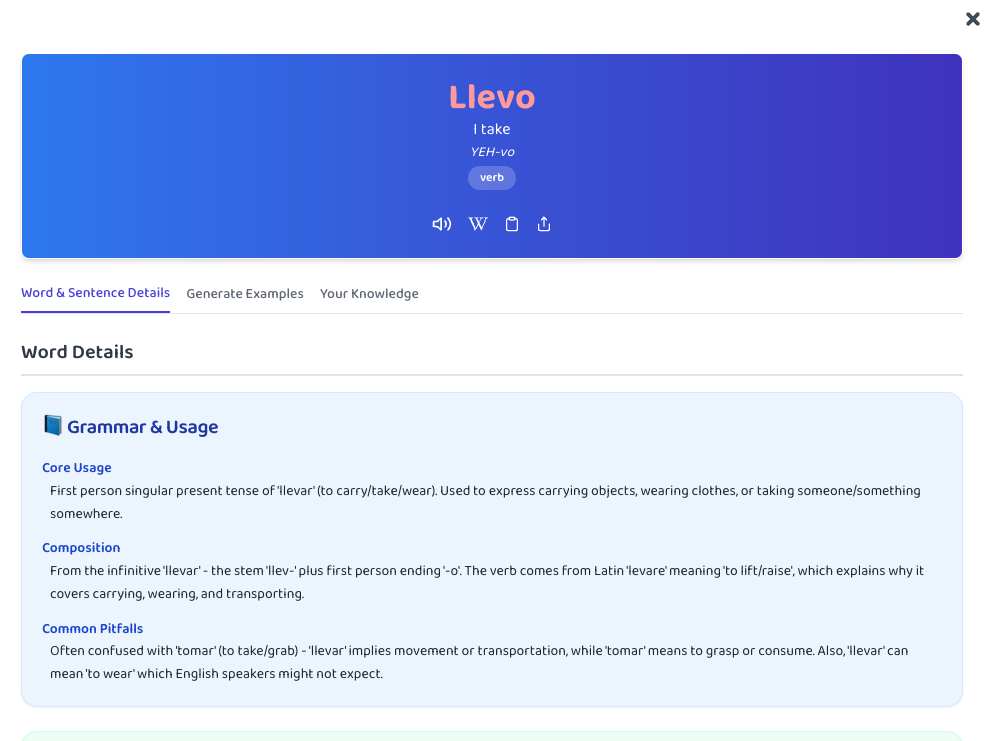
This is where Linguapon's Word Insights is valuable. After saving a word from the Explore section, navigate to the Translation Bank and click on any word you've saved. Insights gives you depth that a single translation cannot:
- How the word is used in real sentences
- Its other meanings and when they apply
- Common learner mistakes
- Patterns or constructions it typically appears in
- Subtle differences from similar words
- Useful conjugations e.g. llevo is the first person singular tense of llevar
Be curious, get lost in the sauce
Language learning isn't just about memorizing words, it's about discovering connections, noticing patterns, and seeing how ideas come together in real sentences. The more you explore, the more your brain naturally recognizes these patterns, and the easier it becomes to express yourself.
This is where curiosity becomes your most powerful tool. Pick a topic that sparks your interest, food, travel, hobbies, or even slang, and dive in. Follow threads of sentences, notice which words appear again and again, and see how they interact in different contexts. Don't worry about learning everything at once. Let yourself wander, experiment, and make small discoveries that build on each other.
A lot of this sounds like hard work, but Linguapon was designed to reduce that friction. As you explore sentences and topics on the website, you can save the words that catch your eye, check their meanings and usage in Word Insights, and start connecting them to form your own mental map of the language.
Thank you for making it this far, and I hope your curiosity keeps you learning more and more.
Written by Elvin, Linguapon Admin